Best Fine-Dining Hotel Stays in Cape Town
Among the hotels on this list, The Cellars-Hohenort in Constantia is the clearest fine-dining address, running two award-winning restaurants across its vineyard-estate grounds. The Conservatory, built around a genuine three-hundred-year-old oak tree, anchors the property's dining reputation, serving traditional recipes in a setting that few Cape Town hotels can match for atmosphere. Set among world-renowned gardens and vineyards on Table Mountain's slopes, the estate treats dining as a central part of the stay rather than a hotel-restaurant afterthought. Travellers weighing a Constantia dinner reservation against a city-centre restaurant should factor in the roughly fifteen-minute drive each way as part of the evening's plan.
Cape Town's fine-dining scene draws heavily on Constantia's winelands, where estate restaurants pair local produce with the region's wine history in a way that a city-centre kitchen can't quite replicate. That regional character means a fine-dining stay here is as much about the estate and its grounds as about the specific tasting menu, a distinction worth understanding before booking a Constantia property purely for dinner.
Where to stay
Dining Under a 300-Year Oak Tree
Fine dining at a Constantia estate works differently than a standalone city-centre restaurant, since the setting itself, vineyards, gardens and a three-hundred-year-old oak tree, becomes part of what's being served. The Cellars-Hohenort's two award-winning restaurants let guests choose between formal and more relaxed settings within the same estate, which matters for a multi-night stay where a single dining room might otherwise feel repetitive by the third evening.
The Conservatory is The Cellars-Hohenort's signature dining room, built directly around a three-hundred-year-old oak tree on the estate's grounds. Traditional recipes anchor the menu here, served in a setting that turns dinner into an extension of the vineyard walk rather than a separate indoor experience, and it's the room most guests mention first when describing the stay afterward. It's the single room most guests mention first when describing the property afterward, ahead of even the pools or the spa. Booking a table there specifically, rather than leaving it to chance at check-in, is worth doing several days ahead during busier stretches of the year.
A second award-winning restaurant on the same estate gives guests a genuine alternative across a multi-night booking, useful for travellers who want fine dining without repeating the same room and menu each evening. Both restaurants draw on the estate's own gardens and Constantia's winelands more broadly, which shapes a menu distinctly tied to the region rather than an interchangeable hotel-restaurant format. Both rooms draw on the estate's own produce and Constantia's broader winelands, which shapes menus distinctly tied to the region rather than an interchangeable format. A guest staying three or four nights can genuinely alternate between the two rooms without repeating either the setting or the menu.
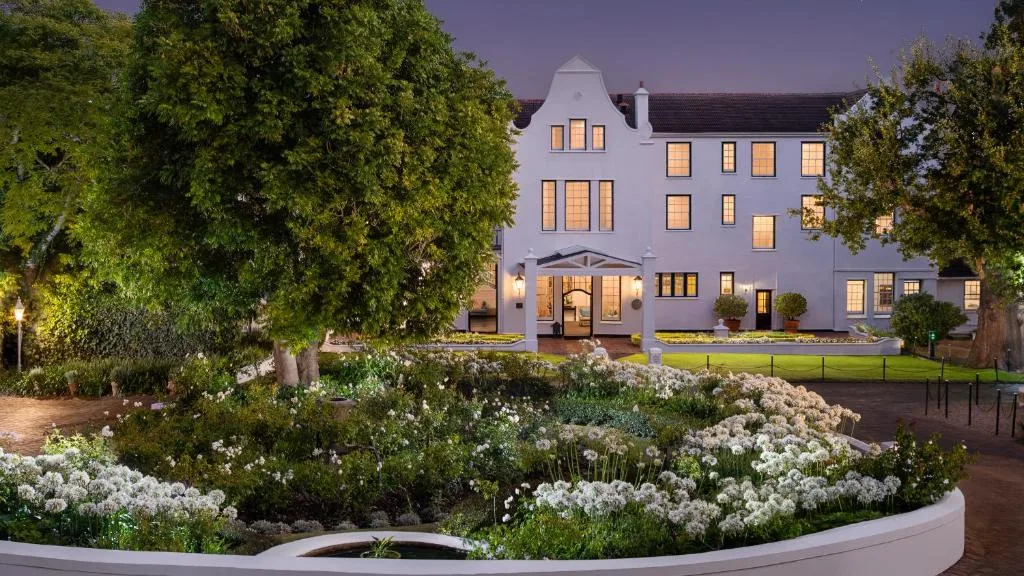
The estate's setting does much of the work beyond the kitchen itself. Rooms are uniquely decorated with artworks by South African artists, and the grounds' vineyards and world-renowned gardens mean a pre-dinner walk becomes part of the evening's rhythm, something a city-centre fine-dining hotel without equivalent grounds can't offer in the same way. That combination of dining and grounds is difficult to replicate at a standalone city-centre restaurant, however good the kitchen itself might be. Few Cape Town hotels outside Constantia can offer that same combination of a working vineyard, historic gardens and award-winning dining under one roof.
For travellers weighing a Constantia fine-dining stay against the city centre, the trade-off is largely about pace: the estate sits roughly fifteen minutes by car from central Cape Town, meaning fine dining here comes bundled with an overnight commitment to the vineyard setting rather than a quick dinner reservation from a downtown hotel. For travellers who treat dinner as the centrepiece of a trip, that overnight commitment tends to be the whole point rather than a drawback. Travellers who treat the meal itself as reason enough for the drive tend to leave the estate already planning a return visit.
A traveler's takeI booked two nights at The Cellars-Hohenort specifically for dinner at The Conservatory, and the meal under that oak tree lived up to every description I'd read beforehand, traditional recipes served in a room that felt genuinely built around the tree rather than positioned near it. Walking the vineyard grounds beforehand, roughly fifteen minutes from the city centre by car, turned dinner into the anchor of the whole stay rather than a single evening's plan.
Local tips
- 1Book The Conservatory at least a few days ahead for a multi-night Constantia stay, the room's reputation fills tables quickly.
- 2Try the estate's second restaurant on a following evening for contrast rather than repeating The Conservatory across a longer stay.
- 3Walk the vineyard grounds before dinner, the pre-meal stroll is part of what makes the estate's dining feel distinct from a city restaurant.
- 4Combine a fine-dining stay with a Fresh Wellness Spa treatment earlier in the day, both are part of the same estate.
- 5Allow roughly fifteen minutes' driving time from the city centre when planning a Constantia dinner reservation from elsewhere.
- 6Ask about seasonal produce on the menu, Constantia's estate restaurants typically adjust dishes around the vineyard's own growing calendar.